

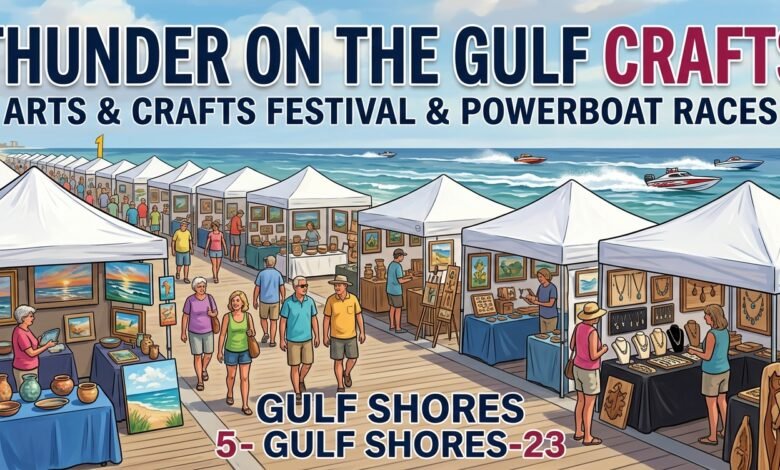
When people search for art thunderonthegulf crafts, they are usually looking for something connected with Gulf Coast creativity, handmade artwork, coastal decorations, or craft ideas inspired by the atmosphere of Thunder on the Gulf. The phrase itself is commonly used online as a shorthand for this broader combination of art, crafts, coastal culture, and creative activities.
There is an important distinction worth making at the beginning. Thunder on the Gulf is primarily associated with offshore powerboat racing along Alabama’s Gulf Coast, particularly around Orange Beach and Gulf Shores. Government records also identify Thunder on the Gulf as a marine event associated with the Gulf Coast Power Boat Association. Meanwhile, many online pages use “art thunderonthegulf crafts” to describe coastal-inspired handmade work, DIY projects, and arts-and-crafts experiences associated with the event or its general coastal setting.
That combination makes the keyword interesting. It brings together the energy of boats and the Art ThunderOnTheGulf Crafts with the slower, hands-on world of making things. From seashell decorations and driftwood displays to paintings, rope projects, jewelry, and family-friendly creative activities, there are plenty of directions this topic can take.
What Does Art ThunderOnTheGulf Crafts Actually Mean?
The phrase art thunderonthegulf crafts is not a traditional art-history term with one universally accepted definition. Instead, it is primarily a search phrase used to connect Thunder on the Gulf with coastal art, handmade creations, and art thunderonthegulf crafts ideas. Several online guides describe the term in this broader sense rather than as the name of one specific artistic movement.
At its simplest, the phrase can be understood as art and craft inspired by the Art ThunderOnTheGulf Crafts Coast atmosphere and the Thunder on the Gulf experience. That can include artwork featuring boats, waves, beaches, marine life, sunsets, coastal landscapes, and nautical details. It can also include practical handmade objects that use materials or colors associated with seaside living.
This distinction matters because online information about the subject is not always consistent. Some websites describe a dedicated arts-and-crafts component as though it were a formal part of Thunder on the Gulf, while other sources emphasize that the primary event is offshore powerboat racing and caution against assuming that every advertised art thunderonthegulf crafts activity is officially connected to the organizers.
For someone interested in the creative side, however, the idea remains useful. You do not need a complicated definition to understand the aesthetic. Think of coastal materials, Gulf-inspired colors, maritime subjects, handmade textures, and practical creativity coming together in one visual language.
The beauty of this style is that it does not demand expensive equipment. A simple wooden board, a few shells, rope, paint, recycled glass, or an old piece of driftwood can become the foundation for something attractive. That accessibility is one reason coastal crafts continue to appeal to beginners as well as experienced makers.
Ultimately, art thunderonthegulf crafts can be viewed as a creative theme rather than a rigid category. It gives artists and hobbyists a starting point, then leaves plenty of room for personal interpretation. You can make something rustic, modern, colorful, minimalist, functional, or completely experimental while still maintaining that Gulf-inspired feeling.
The Coastal Inspiration Behind ThunderOnTheGulf Crafts
The Art ThunderOnTheGulf Crafts Coast naturally provides artists with an enormous collection of visual ideas. Water changes color throughout the day, clouds create dramatic backgrounds, boats introduce strong shapes, and weather constantly changes the appearance of the shoreline. All of these details can become artistic inspiration.
Colors are especially important in coastal artwork. Soft blue, turquoise, sandy beige, white, seafoam green, weathered gray, and warm sunset orange are common choices. A skilled artist does not necessarily copy the landscape literally. Instead, they capture its mood through a carefully chosen palette.
Texture is another major part of coastal art thunderonthegulf crafts design. Driftwood has a naturally worn surface. Rope has a strong woven structure. Seashells provide unusual shapes and subtle patterns. Recycled glass can introduce translucent color. When these materials are combined thoughtfully, the finished piece feels connected to the sea without needing an obvious picture of a beach.
Boats and marine activity can add another layer of inspiration. Because Thunder on the Art ThunderOnTheGulf Crafts is associated with powerboat racing, movement can become an important artistic theme. Artists might use sweeping lines, angled shapes, contrasting colors, or layered materials to suggest speed and motion.
Weather also offers creative possibilities. The word “thunder” itself evokes storms, dark clouds, powerful waves, and dramatic skies. A art thunderonthegulf crafts inspired by this idea does not have to be bright and tropical. Storm-gray wood, deep blue paint, silver accents, and rough textures can create a more dramatic interpretation.
Perhaps the most appealing part is that there is no single correct way to interpret the Gulf. One artist may focus on peaceful beaches, while another may concentrate on boats and racing. Someone else may be inspired by fishing, marine wildlife, sunsets, or family memories. The same coastline can therefore produce completely different creative results.
Popular Materials Used in Coastal-Inspired Crafts
Driftwood is one of the most recognizable materials associated with coastal art thunderonthegulf crafts. Its irregular shape and weathered appearance provide character that manufactured wood often lacks. A piece can be turned into a wall hanging, sign, frame, shelf, decorative boat, or sculptural object.
Rope is another versatile option. Nautical rope can be wrapped around containers, used as hanging material, incorporated into wall art, or woven into decorative pieces. Its texture immediately suggests maritime environments, making it useful even when the finished design is quite modern.
Seashells are popular because they bring natural coastal shapes directly into the artwork. They can be arranged into patterns, attached to frames, incorporated into mosaics, or used as small decorative details. However, responsible sourcing matters. If you collect natural materials from beaches, check local rules before removing shells, sand, driftwood, or other natural objects.
Sea glass or recycled glass can add color and light. Blue and green pieces work particularly well for ocean-themed designs, while clear and frosted pieces can create a softer appearance. Because every fragment can have a different shape, handmade glass artwork often develops a naturally irregular character.
Wood is also useful beyond driftwood. New boards can be painted, stained, carved, or assembled into signs and decorative panels. Reclaimed wood can provide a more rustic appearance, while smooth finished timber works well for contemporary designs.
Paint, wire, beads, fabric, clay, metal, and recycled materials can complete the toolkit. The important point is not to collect every possible supply. Start with a small selection and learn how materials behave. Good craftsmanship usually comes from understanding a few materials deeply rather than owning an enormous craft box.
Types of Art ThunderOnTheGulf Crafts You Can Explore
One popular direction is coastal wall art. This can include painted boards, driftwood arrangements, wave-inspired abstracts, boat silhouettes, or mixed-media compositions. A simple rectangular wooden panel can become a surprisingly effective piece when the materials and colors are balanced carefully.
Another option is nautical decoration. Rope, wooden shapes, miniature boats, anchors, shells, and marine colors can be combined into decorative displays. These pieces work especially well in beach houses, vacation rentals, patios, entryways, and rooms where you want a subtle coastal atmosphere.
Jewelry provides a more portable interpretation of the theme. Sea-glass pendants, shell necklaces, bracelets, earrings, and small maritime charms can all draw inspiration from the Gulf. Handmade jewelry also makes an attractive gift because the finished item is both decorative and personal.
Functional crafts are equally interesting. Serving boards, trays, candle holders, storage baskets, plant holders, coasters, and small shelves can incorporate coastal materials without becoming overly decorative. This approach is particularly useful if you prefer objects that have a practical purpose.
For children, the possibilities become even simpler. Paper boats, fish drawings, shell-inspired collages, ocean paintings, handmade maps, and colorful paper crafts can introduce young creators to the theme without requiring expensive supplies. Some ThunderOnTheGulf-related craft resources specifically promote drawing boats, waves, fish, and other coastal subjects as family activities.
Mixed-media artwork can bring everything together. Imagine a wooden background with painted waves, pieces of rope, small shells, metallic accents, and a simple boat silhouette. The result does not have to look complicated. In fact, leaving some empty space can make the handmade elements stand out more clearly.
Easy Art ThunderOnTheGulf Craft Ideas for Beginners
A driftwood wall hanging is an excellent starting point. Begin with one reasonably flat piece of clean, dry wood. Add a simple painted wave, a few small shells, or a short piece of rope. Finish it with strong hanging hardware, and you have a coastal decoration without needing advanced woodworking skills.
A nautical rope frame is another approachable project. Start with a plain photo frame and wrap rope around its outer edge. Keep the rope tight and consistent, then add one or two small coastal accents. The finished frame can hold a family beach photograph, travel picture, or ocean landscape.
You can also create a simple shell mosaic. Instead of covering an entire surface, arrange a limited number of shells around the border of a wooden panel or mirror. Leaving plenty of background visible makes the design look cleaner and prevents it from becoming visually crowded.
For children, try a paper vArt ThunderOnTheGulf Crafts Coast scene. Give them blue, white, yellow, green, and gray paper and let them create waves, clouds, boats, fish, and beaches. The project is inexpensive and allows children to interpret the coastal environment in their own way.
A sea-glass-style decorative bottle can be made without collecting actual beach glass. Use craft glass pieces or appropriately sourced decorative material and arrange them on a safe surface with suitable adhesive. Avoid treating unknown glass fragments as safe craft material, especially when children are involved.
Finally, consider a coastal memory board. Use a wooden board as the foundation and attach photographs, drawings, small decorative elements, and written memories from a beach trip. Unlike purely decorative crafts, this kind of project becomes a personal keepsake that can grow over time.
How to Make Coastal Art ThunderOnTheGulf Crafts Look Professional
The biggest difference between a casual craft and a polished piece is often composition rather than expensive materials. Before gluing anything permanently, place the materials on the surface and experiment with different arrangements.
Avoid using too many colors at once. A controlled palette usually looks more sophisticated. For example, blue, white, natural wood, and one warm accent color can create a strong coastal appearance without making the design feel chaotic.
Scale matters too. A large piece of driftwood can overwhelm tiny decorative objects, while a small board may look crowded when covered with large shells. Think about visual weight before attaching anything permanently.
Texture should also be balanced. If every part of a project is rough and heavily decorated, the eye has nowhere to rest. Combining textured materials with smooth surfaces creates contrast and makes the handmade elements more noticeable.
Finishing details are easy to overlook. Sand rough wooden edges, remove excess adhesive, clean glass surfaces, and make sure hanging hardware is secure. Small corrections can dramatically improve the final appearance.
Most importantly, do not try to make handmade work look perfectly manufactured. Slight irregularities are part of its charm. The goal is controlled imperfection: the artist should appear intentional, even when the materials themselves have natural variations.
Art ThunderOnTheGulf Crafts for Families and Children
Crafting can turn a coastal trip into a more memorable family experience. Instead of simply taking photographs, children can sketch what they see, collect observations, or create artwork inspired by boats, waves, fish, shells, and sunsets.
Younger children usually benefit from simple activities. Coloring pages, paper shapes, stickers, basic painting, and collage projects allow them to participate without complicated instructions. The emphasis should be on exploration rather than producing a perfect finished object.
Older children can handle more involved projects. They might create handmade maps, design boat illustrations, experiment with photography, build simple models, or keep a nature journal. These activities can combine creativity with observation.
Parents can also turn crafts into storytelling exercises. Ask children to draw a boat and then invent a story about where it is going. Ask them to design a fictional Art ThunderOnTheGulf Crafts Coast lighthouse or create an imaginary marine creature. Suddenly, a simple art project becomes a lesson in creativity and communication.
Safety remains important. Small shells, beads, sharp tools, hot glue, and certain adhesives are not appropriate for unsupervised young children. Adults should choose materials according to the child’s age and remain involved whenever tools or small objects are being used.
The best family craft does not necessarily produce the most beautiful artwork. Sometimes the value is in the conversation that happens while everyone is making something together. A slightly crooked paper boat can become a much better family memory than an expensive souvenir.
Why Handmade Coastal Art Continues to Appeal to People
Handmade art has an advantage that mass-produced decoration often lacks: individuality. Two pieces made from natural materials can never be exactly identical. Even when an artist follows the same general design, differences in wood grain, shell shape, texture, and color create subtle variations.
Coastal crafts also connect physical objects with memories. A person may see a shell-covered frame and immediately remember a family vacation. A piece of driftwood may remind someone of a favorite beach. A boat-themed painting can recall a day spent watching vessels move across the water.
There is also something satisfying about visible craftsmanship. When you can see how a rope was woven, how wood was shaped, or how individual pieces were arranged, the object tells a story about its creation.
Sustainability can add another dimension when materials are responsibly reused. Reclaimed wood, recycled glass, and repurposed objects can receive a second life instead of becoming waste. That does not automatically make every craft environmentally friendly, but thoughtful material choices can reduce unnecessary consumption.
Handmade crafts can also support independent creators. Buying directly from an artist allows the maker to earn from their skills while giving the buyer something with a more personal connection than a generic mass-produced item.
That combination of creativity, memory, individuality, and craftsmanship explains why coastal art remains popular. The appeal is not simply that something looks “beachy.” It is that the finished piece can carry a sense of place.
Tips for Creating Your Own ThunderOnTheGulf-Inspired Craft
Start small. A beginner does not need to build a large wall installation on the first attempt. A coaster, frame, small wooden sign, or simple hanging piece can teach you the fundamentals without creating unnecessary frustration.
Choose one central idea before you begin. Perhaps your theme is boats, waves, marine life, storms, sunsets, or beach memories. Having a central subject makes it easier to decide which materials belong in the design.
Prepare your materials first. Clean and dry wood, organize shells, cut rope to approximate lengths, and test your paint colors. Preparation may not be the most exciting part of crafting, but it saves time later.
Give yourself permission to change direction. Handmade work rarely develops exactly as expected. A material may look different after painting, or an arrangement that seemed good on the table may feel crowded once attached. Adaptation is part of the creative process.
Take photographs before and after finishing a project. Pictures can help you identify what works visually and what you might change next time. They are also useful if you eventually want to share your work online or build a small craft portfolio.
Most importantly, enjoy the process. Crafting is not a race. The objective is not to reproduce somebody else’s work perfectly. Use the coastal theme as inspiration, then add your own colors, memories, ideas, and personality.
How to Choose or Buy Quality Coastal Handmade Art
If you are buying rather than making, look closely at the construction. A beautiful appearance is only one part of quality. Check whether materials are securely attached, edges are finished properly, and hanging mechanisms appear strong enough for the item’s weight.
Ask the artist about the materials when possible. Knowing whether wood is reclaimed, whether glass is recycled, or whether an item was painted by hand can make the purchase more meaningful.
Look for individuality rather than simply searching for the cheapest option. Handmade work often requires considerable time, and two pieces that look similar may involve very different amounts of labor.
If you are purchasing natural-material artwork, ask how those materials were sourced. Responsible collection matters, particularly with shells, wildlife-related materials, and objects taken from protected coastal environments.
For gifts, consider the recipient’s personality. Someone who loves minimal design may prefer a small wooden piece with subtle colors, while another person might enjoy a colorful shell mosaic or elaborate nautical decoration.
Finally, buy something you genuinely like. Trends change quickly, but a well-made handmade piece that has personal meaning can remain enjoyable for years. That is one of the strongest reasons to explore coastal art beyond temporary decoration trends.
Final Thoughts on Art ThunderOnTheGulf Crafts
Art thunderonthegulf crafts is best understood as a broad search phrase connecting Gulf Coast inspiration, handmade creativity, coastal decoration, and the Thunder on the Art ThunderOnTheGulf Crafts name. The exact relationship between individual craft activities and the official powerboat event can vary, so readers should verify specific event details through reliable local or organizer sources before making travel plans.
The creative side of the topic, however, is easy to explore anywhere. You do not need to live beside the Gulf, attend a festival, or own a professional studio to create coastal-inspired art.
A few simple materials can be enough. Wood, rope, paint, shells, recycled glass, paper, fabric, and ordinary household objects can all become useful creative ingredients when handled thoughtfully.
The strongest designs usually focus on balance rather than quantity. A small number of carefully chosen materials can communicate a coastal feeling more effectively than a surface covered with every nautical object available.
For families, these projects can become shared experiences. For artists, they can become a source of experimentation. For homeowners, they can provide distinctive decoration. And for gift shoppers, handmade coastal pieces can offer something more personal than mass-produced souvenirs.
In the end, the real attraction of art thunderonthegulf crafts is the freedom behind the idea. The Gulf can inspire the colors, textures, subjects, and mood, but the finished creation remains yours. Whether you make a simple paper boat with a child or build a detailed driftwood wall piece, the most valuable part is the creative story you put into it.