

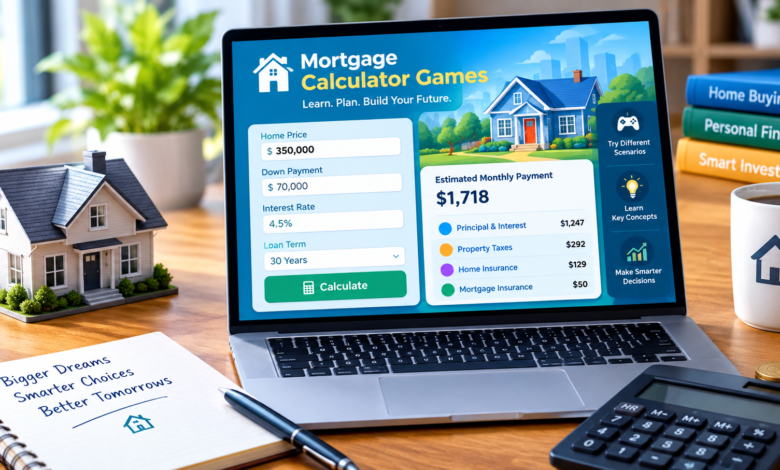
If you have searched for mortgage calculator games, you may have wondered whether it is a financial tool, an online game, or something completely different. The phrase sounds unusual at first because mortgage calculators are normally associated with home loans, monthly payments, interest rates, and budgeting. Games, on the other hand, are usually designed for entertainment. Put the two together, and you get an interesting search term that can refer to several types of online experiences.
The growing interest in mortgage calculator games also reflects a broader trend. People increasingly want to learn complicated subjects through interactive tools instead of reading long explanations. Buying a home can involve confusing numbers, including principal, interest, taxes, insurance, down payments, loan terms, and closing costs. A game-like calculator can make these concepts easier to understand by allowing users to experiment with different financial situations.
For example, imagine changing a down payment from $20,000 to $50,000 and immediately seeing how the estimated monthly payment changes. You could then adjust the interest rate or loan term and compare the results. That kind of interaction feels more engaging than simply reading a definition of amortization.
This article explores what mortgage calculator games can mean, how mortgage calculators work, why game-based financial tools can be useful, and what you should know before relying on their results. Whether you are a student, a first-time homebuyer, a curious internet user, or someone researching financial education tools, understanding the concept can be surprisingly useful.
What Are Mortgage Calculator Games?
Mortgage calculator games are generally interactive experiences that combine mortgage calculations with game-like features. Instead of simply entering numbers into a traditional calculator, users may be asked to make decisions about purchasing a home, selecting a loan, managing a budget, or handling unexpected expenses.
The exact meaning of the term can vary depending on where you encounter it. Some people may use it to describe an educational game about mortgages, while others may be referring to a website or online activity where mortgage calculations are part of the gameplay. There is not necessarily one universally recognized product called “Mortgage Calculator Games.”
The educational version is perhaps the easiest concept to understand. A game might give you a fictional income, savings amount, credit profile, and target home price. You then choose a property and mortgage calculator games structure. The system calculates whether your choices are affordable and shows how your monthly expenses change.
Another possibility is a simulation. A mortgage simulation can allow users to experience different financial outcomes without putting real money at risk. You might discover that a lower interest rate dramatically affects total interest, or that extending a loan term can reduce monthly payments while increasing the total amount paid over time.
The game-like approach can make financial concepts less intimidating. mortgage calculator games terminology can seem complicated when you first encounter it, but interacting with numbers tends to make abstract ideas more concrete. Instead of simply learning what a down payment is, you can see how changing it affects your loan.
Ultimately, the value of mortgage calculator games depends on how accurately they model real-world mortgage calculator games costs. A colorful interface may be entertaining, but financial accuracy matters much more than presentation. If the tool is being used for genuine planning, users should always verify important figures with reliable mortgage professionals and lenders.
How Does a Mortgage Calculator Work?
A traditionalmortgage calculator games estimates the amount you may need to pay toward a home loan. The calculation usually depends on several important factors, including the loan amount, interest rate, and repayment period. Some advanced calculators also include property taxes, homeowners insurance, mortgage insurance, and other expenses.
The basic calculation begins with the principal, which is the amount borrowed. If a house costs $300,000 and you make a $60,000 down payment, the starting loan amount would generally be $240,000 before considering other financing costs.
Interest is another major part of the calculation. Lenders charge interest for providing the money used to purchase the property. Even a relatively small difference in the interest rate can have a significant effect when applied to a large loan over many years.
The loan term also matters. A common mortgage calculator games term is 30 years, but shorter options may be available. A shorter term can result in higher monthly payments, while potentially reducing the amount of interest paid over the life of the loan.
A mortgage calculator games essentially brings these variables together and produces an estimated payment. More sophisticated tools may break that payment into principal and interest and then add estimated taxes, insurance, or mortgage insurance.
This is where a game-based calculator can become interesting. Instead of treating the calculation as a one-time answer, users can change individual variables and observe the results. That interactive process can help people understand why mortgage calculator games payments change and which factors have the greatest impact.
Why Turn Mortgage Calculations Into a Game?
Financial topics are not always exciting. Terms such as amortization, annual percentage rate, principal, escrow, and loan-to-value ratio can make even experienced readers pause. Turning some of these concepts into an interactive experience can make them easier to understand.
Games naturally encourage experimentation. A person may be more willing to test different mortgage calculator games scenarios when there is no real financial consequence attached to the decision. They can see what happens when the home price increases, the down payment decreases, or the interest rate changes.
This approach can be especially useful for younger people learning about personal finance. Someone who has never purchased a home may have difficulty imagining what a $2,000 or $3,000 monthly housing payment means for an overall budget. A simulation can provide that context.
Game mechanics can also encourage users to think about trade-offs. For example, choosing a more expensive home might make the virtual experience more difficult because the monthly payment consumes a larger portion of the fictional budget.
That kind of learning is different from memorizing financial definitions. Users are actively making decisions and seeing consequences. The experience can therefore encourage better understanding of financial cause and effect.
However, gamification should not make serious financial decisions appear trivial. Buying a home is one of the largest financial commitments many people make. A game can teach concepts, but it should not replace professional advice, lender estimates, or careful financial planning.
Understanding Principal and Interest Through Gameplay
Principal is the portion of the mortgage calculator games balance that represents the money borrowed to purchase the property. When you make a principal payment, you reduce the amount you owe to the lender.
Interest works differently. It represents the cost of borrowing money. In the early stages of many amortizing mortgages, a significant portion of the scheduled payment can go toward interest because the outstanding loan balance is still relatively large.
A mortgage calculator games can demonstrate this concept in a much more memorable way than a textbook explanation. Imagine starting with a virtual $250,000 mortgage. Each simulated monthly payment could show how much goes toward principal and how much goes toward interest.
As the fictional borrower continues making payments, the balance gradually falls. The interest portion may also decline because interest is calculated based on the outstanding balance.
This can help users understand why making additional principal payments can potentially reduce future interest costs, depending on the loan terms and circumstances. The game can turn an abstract mathematical process into something visible.
The same simulation can demonstrate the long-term effect of interest rates. Two players could receive identical home prices and down payments but different interest rates. Over several decades, their total costs could become noticeably different.
The Role of Down Payments in mortgage calculator games
The down payment is another important variable that can be incorporated into mortgage calculator games simulations. It represents the amount of money the buyer contributes toward the purchase rather than borrowing from the lender.
Suppose a fictional property costs $350,000. One player might make a $35,000 down payment, while another puts down $70,000. The second player generally needs to borrow less, which can reduce the size of the mortgage calculator games payment.
A game can make this relationship immediately visible. Players might start with a fixed amount of virtual savings and decide how much to put toward the property and how much to keep available for other expenses.
That decision introduces an important real-world lesson: putting more money down is not automatically the best choice in every situation. Homebuyers also need to consider emergency savings, closing costs, moving expenses, maintenance, and other financial obligations.
A well-designed mortgage calculator games simulation can therefore include unexpected events. For example, the virtual homeowner might suddenly face a repair bill. If the player used every available dollar for the down payment, they may discover that their emergency reserve is too small.
This creates a more realistic picture of homeownership. Buying a house is not only about qualifying for a mortgage. It is also about maintaining enough financial flexibility to handle life after the purchase.
How Interest Rates Change the Game
Interest rates are among the most important variables in mortgage calculations. Even a difference of a fraction of a percentage point can affect the monthly payment and total interest paid over a long loan period.
In a mortgage calculator games, interest rates can become a strategic variable. A player might be given multiple hypothetical loan offers and asked to choose between them.
For example, one loan might have a lower interest rate but higher upfront costs. Another could have a slightly higher rate but fewer upfront expenses. Comparing those options teaches users that the lowest advertised rate is not necessarily the only factor worth considering.
A game could also simulate changing market conditions. Players might see what happens when rates rise before they purchase a home or fall after they have already selected a fictional mortgage.
This can introduce the concept of refinancing. In real life, refinancing involves replacing an existing mortgage with a new loan, subject to qualification, costs, and market conditions. A simulation can show why borrowers consider refinancing without requiring them to make a real financial decision.
The key lesson is that interest rates affect much more than a single monthly payment. Over many years, the rate can have a substantial influence on the total cost of borrowing.
Mortgage Calculator Games as Financial Education Tools
One of the strongest potential uses of mortgage calculator games is education. Schools, financial literacy programs, nonprofit organizations, and personal finance websites can use interactive simulations to explain homeownership.
Students can learn about budgeting by being given fictional salaries and expenses. They can then determine whether a particular mortgage fits within their virtual budget.
Teachers can also use simulations to explain mathematical concepts. Mortgage calculations involve percentages, interest, multiplication, division, and long-term financial projections.
The interactive nature of a game can make these mathematical concepts more relevant. Instead of calculating numbers only for an abstract homework problem, students can see how those numbers influence a fictional person’s financial life.
Financial literacy is particularly important because mortgage decisions can have consequences lasting decades. A basic understanding of loan terms can help consumers ask better questions when speaking with lenders.
Still, educational simulations should clearly distinguish fictional examples from actual lending offers. Interest rates, qualification requirements, taxes, insurance costs, and other factors vary between borrowers and locations.
What Should You Look for in a Good Mortgage Calculator?
If you are using a mortgage calculator for real planning rather than entertainment, accuracy should be your first priority. The tool should clearly explain what assumptions it uses and what information you need to provide.
At minimum, a useful calculator should allow you to enter the home price, down payment, interest rate, and loan term. More advanced calculators may also include property taxes, homeowners insurance, mortgage insurance, and homeowners association fees.
Transparency is equally important. A trustworthy calculator should not make its results appear more precise than they actually are. Mortgage estimates can change depending on lender terms, taxes, insurance, credit, and other circumstances.
A good tool should also make it easy to compare scenarios. You might want to compare a 15-year loan with a 30-year loan or see how different down payments affect your estimated payment.
The interface should be simple enough for ordinary users to understand. Complicated financial tools can become frustrating if users cannot determine which numbers they are supposed to enter.
Finally, remember that a calculator provides an estimate. It does not guarantee that a lender will approve a particular loan or offer a specific interest rate. Real mortgage decisions require more detailed information.
Common Mistakes People Make With Mortgage Calculators
One common mistake is focusing only on the monthly mortgage payment. A payment may look affordable on its own while becoming expensive once property taxes, insurance, maintenance, utilities, and other housing costs are included.
Another mistake is assuming that the calculator’s interest rate is guaranteed. Online calculators often require users to enter an estimated rate. Your actual rate can depend on many factors, including market conditions and borrower qualifications.
Some users also forget about closing costs. Purchasing a home can involve expenses beyond the down payment. Depending on the transaction, buyers may encounter lender fees, appraisal costs, title-related expenses, prepaid items, and other charges.
Ignoring maintenance is another common error. Homeowners are responsible for repairs and upkeep that renters may not directly pay for. A realistic budget should account for the possibility of future maintenance expenses.
People can also make the mistake of borrowing the maximum amount they qualify for. Qualification and affordability are not identical concepts. A lender may determine that you can technically afford a certain payment, but your personal financial goals may suggest choosing a lower-cost property.
Finally, users sometimes treat calculators as financial advice. They are useful planning tools, but they cannot understand every detail of your financial situation. A calculator should support your research rather than replace professional guidance.
Are Mortgage Calculator Games Actually Useful?
The usefulness of mortgage calculator games depends on what you expect them to accomplish. If your goal is learning, experimenting, or understanding basic mortgage concepts, they can be valuable.
They can make financial concepts easier to visualize. Seeing a loan balance decline over time is often more intuitive than reading about amortization.
They can also encourage curiosity. Once users understand how changing one variable affects the outcome, they may begin asking more sophisticated questions about loan terms, interest rates, and affordability.
For prospective homebuyers, the educational benefit can be particularly helpful before speaking with lenders. Understanding basic mortgage terminology can make conversations easier and help borrowers recognize which questions they should ask.
However, entertainment-focused games may simplify real-world lending. A fictional simulation may not account for credit requirements, lender-specific fees, changing interest rates, local taxes, or individual circumstances.
So, mortgage calculator games are best viewed as learning tools. They can help you understand the mechanics behind a mortgage, but actual home financing requires more detailed research.
How to Use a Mortgage Calculator Responsibly
Start with realistic numbers. If you are using a calculator to explore a potential purchase, avoid choosing an unrealistically low interest rate simply because it produces a more attractive result.
Next, include as many relevant expenses as the calculator allows. Property taxes, homeowners insurance, mortgage insurance, and association fees can significantly change your monthly housing cost.
It is also useful to compare multiple scenarios. Instead of calculating one mortgage and stopping there, test different down payments, loan terms, and interest rates.
Think about the long-term picture. A lower monthly payment can sound appealing, but extending the repayment period may increase the total interest paid.
You should also leave room for unexpected expenses. A household budget that works only when everything goes perfectly may become difficult when a major repair, job change, or other financial event occurs.
Most importantly, treat the result as an estimate. Before making a real purchase, review actual loan estimates and other documents from qualified professionals. Use the calculator to prepare, not to make the final decision by itself.
The Future of Mortgage Calculator Games
Financial technology continues to become more interactive. As digital tools improve, mortgage education could become increasingly personalized and engaging.
Future simulations could potentially combine budgeting, home selection, mortgage calculations, taxes, maintenance, and long-term financial planning into a single experience.
Artificial intelligence could also make these simulations more conversational. Instead of entering numbers manually, a user might describe a fictional financial situation and receive an interactive scenario.
Virtual reality and immersive interfaces could eventually make financial simulations feel more like complete environments. Users could walk through a virtual home, examine its costs, and see how purchasing it affects their fictional budget.
However, greater sophistication also creates a greater need for accuracy. Financial tools should clearly identify assumptions and avoid presenting estimates as guaranteed outcomes.
The best future mortgage games will probably combine entertainment with responsible education. They can make complicated subjects approachable while still reminding users that real financial decisions require careful research.
Final Thoughts on Mortgage Calculator Games
Mortgage calculator games are an interesting combination of financial education and interactive technology. Although the phrase can refer to different types of tools or experiences, the central idea is straightforward: use mortgage calculations in a more engaging format.
The concept can help users understand important topics such as principal, interest, down payments, loan terms, affordability, and long-term borrowing costs.
For students, these simulations can turn financial mathematics into practical learning. For prospective homebuyers, they can provide a safe way to experiment with different scenarios before dealing with real lenders and loan documents.
At the same time, users should understand the limitations. A game or calculator cannot perfectly reproduce every part of an actual mortgage transaction. Real-world costs depend on individual circumstances, lender requirements, market conditions, taxes, insurance, and many other variables.
The smartest approach is to use mortgage calculator games as a starting point. Experiment with different scenarios, learn how the numbers interact, and develop a better understanding of home financing.
Once you understand the basics, you can move from the game-like experience to more detailed financial research. That combination of curiosity, calculation, and careful planning can make the complicated world of mortgages much easier to navigate.





One Comment