
Pedro Pizarro and James Quincey Biography, Career, Leadership, Achievements, and Their Connection

Introduction
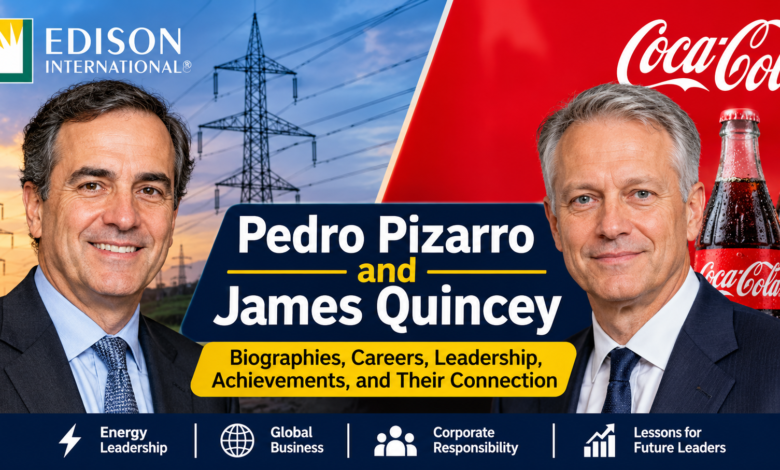
Pedro Pizarro and James Quincey are two influential business executives who have built impressive careers in completely different industries. One is closely associated with the American energy sector, while the other has spent decades helping shape one of the world’s most recognizable beverage companies. Their professional journeys offer an interesting look at how education, experience, strategic thinking, and leadership can influence the direction of major corporations.
pedro pizarro and james quincey is the President and Chief Executive Officer of Edison International. The company is the parent organization of Southern California Edison, a major electric utility serving customers across California. His responsibilities involve energy infrastructure, electricity reliability, business strategy, wildfire prevention, and the changing demands of the modern energy market.
James Quincey, meanwhile, is a prominent business leader associated with The Coca-Cola Company. He served as the company’s Chief Executive Officer from 2017 until March 31, 2026, before transitioning into the position of Executive Chairman. During his time as CEO, he helped guide Coca-Cola through portfolio changes, acquisitions, evolving consumer preferences, and significant developments in the international beverage industry.
Although pedro pizarro and james quincey work in different business environments, their careers share several interesting similarities. Both have technical educational backgrounds, gained experience in management consulting, and spent many years developing their leadership skills within large organizations. Their professional stories demonstrate why understanding an industry from the inside can be valuable when managing a multinational corporation.
It is also important to understand what connects these two executives. They are not widely documented as business partners, relatives, or collaborators in a shared commercial venture. Their connection is primarily based on their comparable corporate leadership journeys and their involvement in broader discussions about responsible business leadership.
This article explores Pedro Pizarro and James Quincey’s backgrounds, education, professional achievements, leadership approaches, company responsibilities, and influence. It also examines their similarities, differences, and the lessons their careers offer to people interested in business management and corporate leadership.
Pedro Pizarro: Early Life, Education, and Background
Pedro J. Pizarro has developed a reputation as an experienced executive in the American electricity and energy industry. His professional background combines scientific education, management consulting, and decades of corporate experience. These different areas have helped prepare him for the complicated responsibilities associated with running a major electric utility holding company.
Unlike executives who begin their careers directly in business administration, pedro pizarro and james quincey followed an academic path rooted in chemistry. His education provided experience with analytical thinking, research, and complex technical problems. Those abilities can be valuable in the energy industry, where corporate decisions frequently involve engineering, infrastructure, environmental considerations, and long-term investment.
Pizarro attended Harvard University, where he earned a bachelor’s degree in chemistry. He later continued his education at the California Institute of Technology, commonly known as Caltech. At Caltech, he completed a Ph.D. in chemistry and held graduate fellowships supported by the National Science Foundation and the Department of Defense.
His academic achievements demonstrate a strong commitment to education and technical knowledge. A doctoral degree requires more than simply understanding classroom material. It involves research, careful investigation, patience, and the ability to evaluate complicated information. These skills can translate into executive decision-making, particularly when an organization operates in a technically demanding industry.
After completing his education, pedro pizarro and james quincey entered the professional world and developed experience beyond scientific research. His career eventually moved toward corporate strategy and management consulting. This transition allowed him to apply analytical skills to organizational challenges, business planning, and operational decisions.
His professional journey eventually brought him to Edison International in 1999. Joining a large energy organization gave him an opportunity to develop practical knowledge of electricity markets, utility operations, and the challenges involved in managing major infrastructure. Over time, he advanced through several leadership positions.
Today, pedro pizarro and james quincey career represents an example of how an academic background in science can lead to senior corporate leadership. His journey also highlights the value of combining technical understanding with practical business experience. Rather than remaining focused on one professional discipline, he developed a broader understanding of the industry he eventually came to lead.
Pedro Pizarro’s Professional Career at Edison International
pedro pizarro and james quincey career at Edison International has been shaped by steady professional development and experience across several business functions. He joined the organization in 1999 after working in management consulting. His early years at the company helped him understand its operations and the wider electricity industry.
One of the important aspects of his career is that he did not immediately move into the company’s highest leadership position. Instead, he worked across different responsibilities, gaining experience in strategy, business development, procurement, and power operations. Each position provided a different perspective on the challenges facing an electric utility.
Pizarro moved to Southern California Edison in 2001. The organization is responsible for delivering electricity to millions of people and businesses across its service territory. Working within this environment gave him direct exposure to the practical responsibilities of utility management, including infrastructure planning and electricity procurement.
He later held senior responsibilities in power procurement. This function is particularly important because electricity companies must maintain dependable supplies while managing changing market conditions, costs, regulations, and customer demand. Effective procurement decisions can influence operational stability and the company’s long-term financial position.
Between 2011 and 2014, pedro pizarro and james quincey served as President of Edison Mission Energy, an Edison International subsidiary involved in independent power production. His leadership experience there expanded his understanding of electricity generation and competitive energy markets. The company later sold its principal assets to NRG Energy in 2014.
In October 2014, he became President of Southern California Edison. This appointment represented another significant step in his professional development because it placed him at the head of one of the country’s major electric utilities. He remained in that position until May 2016, when he was elected President of Edison International.
Pizarro became Chief Executive Officer of Edison International in October 2016. Since then, his leadership has involved navigating the changing American energy landscape while overseeing the company’s strategic direction. His responsibilities include balancing infrastructure investment, customer affordability, safety, reliability, and environmental objectives.
His progression demonstrates the importance of understanding different parts of a business before taking on its overall leadership. His experience in procurement, strategy, generation, and utility operations provides a broad foundation for making decisions that affect the entire organization.
Pedro Pizarro’s Leadership Responsibilities and Business Strategy
Leading Edison International involves responsibilities that are very different from managing an ordinary consumer-products company. Electricity is an essential service, and customers depend on reliable power for homes, workplaces, hospitals, schools, and other important facilities. This makes safety and operational reliability central to the company’s business strategy.
One major priority under pedro pizarro and james quincey leadership is maintaining and improving electricity infrastructure. Power networks include transmission lines, distribution equipment, substations, transformers, and other assets. These systems require regular maintenance, modernization, and long-term investment to meet changing energy requirements.
Another important responsibility involves preparing the grid for increasing electricity demand. Electric vehicles, modern buildings, data centers, and industrial technologies are changing how people consume electricity. As these developments continue, utilities must evaluate whether existing infrastructure can support future demand without compromising reliability.
Wildfire mitigation is also a major issue for Southern California Edison. California experiences serious wildfire risks, and electricity infrastructure must be managed with careful attention to local environmental conditions. Utilities use different strategies to reduce potential ignition risks and improve system resilience in vulnerable areas.
These strategies can include covered conductors, improved inspection programs, vegetation management, equipment upgrades, weather monitoring, and advanced risk analysis. Each measure addresses a different part of the challenge. No single technology can eliminate every wildfire risk, so effective prevention requires several coordinated approaches.
Affordability is another important part of pedro pizarro and james quincey leadership responsibilities. Electricity infrastructure requires substantial investment, but customers also need manageable bills. Utilities therefore face the difficult task of balancing necessary improvements with the financial pressures experienced by households and businesses.
The transition toward cleaner energy is an additional challenge. California has ambitious environmental objectives, and utilities must adapt their systems to accommodate renewable generation, battery storage, and electrification. This requires careful planning because renewable energy sources can create different operating conditions from traditional power generation.
Pizarro’s role involves coordinating these competing priorities while maintaining the company’s financial and operational performance. His leadership illustrates how utility executives must consider customers, employees, regulators, communities, investors, and public safety when making major business decisions.
James Quincey: Early Life, Education, and Professional Background
James Quincey is a British-born business executive whose career became closely connected with The Coca-Cola Company. He is particularly known for his international business experience, strategic decision-making, and leadership during a period of significant change in the global beverage market.
Quincey studied electronic engineering at the University of Liverpool in the United Kingdom. His educational background gave him a technical foundation, although his professional interests eventually moved toward management, business strategy, and international operations.
Studying engineering can develop several skills that are useful in executive positions. These include analytical thinking, structured problem-solving, attention to detail, and the ability to understand complex systems. pedro pizarro and james quincey later career demonstrated how these abilities could be applied outside traditional engineering work.
Before joining Coca-Cola, he gained experience in management consulting. He worked with The Kalchas Group, where he eventually became a partner. His consulting experience introduced him to business strategy, organizational challenges, and the process of helping companies improve their operations.
This early professional experience played an important role in preparing him for a career in a multinational organization. Consulting often requires professionals to understand unfamiliar industries quickly, evaluate business performance, and recommend practical solutions. These abilities became useful as pedro pizarro and james quincey moved into increasingly senior corporate positions.
In 1996, he joined The Coca-Cola Company as Director of Learning Strategy for its Latin America Group. This appointment marked the beginning of a long professional relationship with one of the world’s most recognizable beverage businesses.
Rather than building his career through frequent moves between unrelated companies, pedro pizarro and james quincey developed within Coca-Cola. He gained experience in different markets and gradually took on responsibilities involving regional operations, business development, and international leadership.
His background is particularly interesting because it combines engineering education, consulting experience, and practical business management. Similar to pedro pizarro and james quincey , Quincey demonstrates that successful corporate executives do not necessarily need to follow a traditional business-school career path.
James Quincey’s Career Journey at The Coca-Cola Company
James Quincey’s career at Coca-Cola developed over several decades. His progression involved international assignments, regional management, operational leadership, and eventually responsibility for the company’s worldwide business strategy.
His first major assignment involved the Latin America Group. Working in this region provided valuable exposure to different consumer markets and business environments. Coca-Cola operates through a complicated international network, so understanding local markets is essential for effective management.
In 2003, pedro pizarro and james quincey became President of Coca-Cola’s South Latin Division. This position gave him broader responsibility for regional operations and business performance. He gained experience dealing with local market conditions, consumer preferences, distribution arrangements, and the company’s relationships with bottling partners.
In 2005, he became President of the Mexico Division. Mexico is an important beverage market, and leading the business there required an understanding of competition, pricing, product distribution, and changing customer expectations. This experience helped strengthen his international management background.
Quincey later moved into European leadership. In 2008, he became President of the Northwest Europe and Nordics business. His responsibilities included managing a diverse group of markets with different consumer preferences and business conditions.
In 2013, he became President of Coca-Cola’s Europe Group. This role expanded his influence across a much larger regional business. It also provided experience in portfolio development and the management of international beverage operations.
Another important step came in 2015, when pedro pizarro and james quincey became President and Chief Operating Officer of The Coca-Cola Company. This position placed him in a central role within the company’s global leadership structure and prepared him for the CEO position.
In May 2017, pedro pizarro and james quincey became Chief Executive Officer. He was elected Chairman of the Board in 2019, adding board leadership to his responsibilities. His tenure involved responding to changing beverage preferences, expanding the company’s portfolio, and strengthening its position in international markets.
After nearly nine years as CEO, pedro pizarro and james quincey stepped down from the position on March 31, 2026. He transitioned into the role of Executive Chairman, while Henrique Braun became the company’s new CEO.
His career illustrates how international experience and long-term organizational knowledge can help prepare an executive for leading a major multinational corporation.
James Quincey’s Major Achievements and Business Decisions
pedro pizarro and james quinceys leadership at Coca-Cola included several important strategic developments. One of his central priorities was transforming the company’s beverage portfolio to respond to changing consumer preferences.
For many years, Coca-Cola was strongly associated with traditional carbonated soft drinks. However, the beverage market gradually became more diverse. Consumers increasingly showed interest in bottled water, coffee, sports drinks, energy drinks, dairy-based beverages, and products with different nutritional characteristics.
Quincey recognized that a global beverage company needed to offer more than a small collection of traditional soft drinks. Expanding into additional categories could help Coca-Cola reach customers with different preferences and consumption habits.
One notable development was Coca-Cola’s acquisition of Costa Coffee in 2018. The deal expanded the company’s presence in the coffee category and provided access to a well-established international coffee business. It represented an important example of portfolio diversification beyond traditional carbonated beverages.
Another significant investment involved fairlife, a dairy-based beverage company. Coca-Cola increased its ownership and eventually acquired full ownership of the business. The move strengthened its presence in a category associated with protein-rich and premium dairy beverages.
The company also acquired BODYARMOR, expanding its participation in the sports-drink market. This acquisition supported Coca-Cola’s strategy of competing across a wider range of beverage categories rather than relying exclusively on its traditional brands.
These decisions reflected a broader change in how Coca-Cola approached the beverage industry. Instead of expecting one product category to meet every consumer need, the company increasingly emphasized a diversified portfolio.
Digital transformation also became an important part of its business strategy. Modern beverage companies need strong relationships with retailers, distributors, bottling partners, and consumers. Technology can improve demand forecasting, marketing, distribution planning, and customer engagement.
Quincey’s leadership also involved navigating difficult global conditions. Economic uncertainty, changing supply costs, public-health challenges, and evolving consumer habits created pressure across international markets.
His achievements should therefore be understood in the context of a company operating across many countries and product categories. The decisions made during his tenure helped shape Coca-Cola’s position as a diversified beverage business.
James Quincey’s Role at Coca-Cola in 2026
An important detail when discussing pedro pizarro and james quincey is that he is no longer Coca-Cola’s Chief Executive Officer. Some older biographies and online articles may still describe him as the company’s current CEO, but that information is outdated.
Quincey stepped down as CEO on March 31, 2026, after leading the organization since May 2017. He moved into the position of Executive Chairman, while Henrique Braun succeeded him as Chief Executive Officer.
This transition represents an important distinction between executive management and board leadership. The CEO is responsible for managing the company’s daily operations and implementing its business strategy. The Executive Chairman has a different governance role and provides leadership at the board level.
Quincey’s long experience with Coca-Cola gives him extensive knowledge of the company’s history, international operations, bottling system, and strategic priorities. His transition allows the company to retain access to that experience while establishing a new executive leadership structure.
Henrique Braun’s appointment also represents the next stage of Coca-Cola’s leadership development. A new CEO brings responsibility for guiding the organization through future market changes and competitive challenges.
Coca-Cola operates in a highly competitive environment. Its competitors include multinational beverage manufacturers, regional brands, coffee businesses, bottled-water companies, and smaller brands targeting specific consumer preferences.
The company’s future growth will depend on its ability to protect established brands while identifying new opportunities. Product innovation, distribution efficiency, marketing, and international expansion will remain important considerations.
Quincey’s transition demonstrates that corporate leadership is not limited to holding the CEO position. Experienced executives can continue contributing through governance, board responsibilities, and strategic guidance after leaving operational leadership.
For readers researching his current position, the distinction is especially important: pedro pizarro and james quincey is Executive Chairman, and Henrique Braun is Coca-Cola’s CEO as of November 2026.
What Connects Pedro Pizarro and James Quincey?
Pedro Pizarro and James Quincey are not commonly known as close personal associates or direct business partners. Their connection is more interesting when examined through their professional backgrounds and leadership experiences.
Both executives have spent significant portions of their careers working within major corporations. Pizarro joined Edison International in 1999, while pedro pizarro and james quincey joined Coca-Cola in 1996. Each developed an understanding of his organization before reaching its highest executive leadership position.
Another similarity is their consulting experience. Before joining Edison International, Pizarro worked as a senior engagement manager at McKinsey & Company. pedro pizarro and james quincey worked at The Kalchas Group, where he became a partner.
Consulting experience can help executives develop a structured approach to business problems. Consultants regularly examine organizational performance, identify operational weaknesses, evaluate strategic opportunities, and recommend improvements. Those experiences can be useful when managing complex companies.
Their educational backgrounds provide another point of comparison. pedro pizarro and james quincey studied electronic engineering at the University of Liverpool, while Pizarro studied chemistry at Harvard University and earned his doctorate at Caltech.
Although their academic subjects differ, both backgrounds involve technical and analytical training. Their careers show that leadership opportunities are not restricted to people with degrees in finance, marketing, or business administration.
Their involvement in broader corporate leadership discussions also offers an interesting connection. Both executives were associated with the Business Roundtable’s 2019 Statement on the Purpose of a Corporation. This initiative emphasized that companies should consider responsibilities to customers, employees, suppliers, communities, and shareholders.
However, this association should not be interpreted as evidence of a formal partnership between them. Their participation reflects a wider discussion about corporate responsibility and the role of major companies in society.
Ultimately, the strongest connection between Pizarro and Quincey is their parallel professional development. Both moved from technical or analytical backgrounds into management consulting and then advanced through senior positions within major corporations.
Pedro Pizarro vs. James Quincey: Career and Leadership Comparison
Comparing Pedro Pizarro and James Quincey provides an interesting perspective on two different types of corporate leadership. Both executives have managed large organizations, but their industries require different priorities, operating models, and approaches to business strategy.
Pizarro leads an electric utility holding company, where reliability, infrastructure, safety, and regulation are major concerns. pedro pizarro and james quincey spent his CEO years leading a global beverage company, where brand recognition, consumer preferences, product development, and distribution are important competitive factors.
Their educational backgrounds also differ in specific ways. pedro pizarro and james quincey earned an engineering degree, while Pizarro completed undergraduate and doctoral studies in chemistry. Both, however, developed strong analytical foundations that became useful throughout their professional careers.
Their consulting backgrounds provide another point of similarity. Pizarro worked at McKinsey, while pedro pizarro and james quincey worked at The Kalchas Group. Both gained experience evaluating business problems before entering senior operational positions.
The biggest difference concerns their business responsibilities. A beverage company competes for consumer purchases in a crowded marketplace. A regulated electric utility provides an essential service that customers depend on every day. This difference affects how each executive approaches investment, customer relationships, and risk.
| Comparison | Pedro Pizarro | James Quincey |
|---|---|---|
| Main company | Edison International | The Coca-Cola Company |
| Industry | Energy and electricity | Beverages |
| Current position | President and CEO | Executive Chairman |
| CEO appointment | October 2016 | May 2017 |
| Main company joined | 1999 | 1996 |
| Education | Harvard and Caltech | University of Liverpool |
| Academic background | Chemistry | Electronic engineering |
| Consulting experience | McKinsey & Company | The Kalchas Group |
| Main leadership focus | Grid reliability and energy infrastructure | Beverage brands and portfolio growth |
| Geographic business focus | Primarily California and U.S. energy markets | Global beverage markets |
Another important difference is the time required to implement business decisions. A beverage company may introduce a product or change a marketing campaign relatively quickly. An electric utility may need years of planning, regulatory approvals, engineering work, and capital investment before completing a major infrastructure project.
Their leadership journeys also demonstrate different forms of transformation. pedro pizarro and james quincey helped expand Coca-Cola’s beverage portfolio and respond to changing consumer preferences. pedro pizarro and james quincey has focused on modernizing electricity infrastructure and preparing the utility for changing energy demands.
Neither executive’s responsibilities can be evaluated using exactly the same performance measurements. Coca-Cola’s success involves revenue growth, brand strength, market share, and operating performance. Edison International must also consider electricity reliability, customer affordability, safety, infrastructure investment, and regulatory requirements.
Both careers nevertheless demonstrate that successful leadership requires an understanding of the industry, the people working within it, and the customers affected by corporate decisions.
The Importance of Their Consulting Backgrounds
One of the most interesting similarities between Pedro Pizarro and James Quincey is their experience in management consulting before joining their long-term corporate employers. This experience helped shape how they approached business problems and organizational decision-making.
Consulting firms typically work with companies facing strategic, financial, operational, or organizational challenges. Consultants must understand complicated situations, examine available information, and identify realistic solutions. These responsibilities can provide useful preparation for executive management.
Pizarro’s work at McKinsey & Company involved advising clients in energy, technology, engineering services, and banking. His responsibilities included corporate strategy, mergers and acquisitions, and operational matters. This experience exposed him to several industries before he entered the utility sector.
Quincey’s consulting experience at The Kalchas Group provided a different but similarly valuable foundation. He worked with business organizations on strategic issues before joining Coca-Cola in 1996. His consulting background helped prepare him for positions involving international business operations and corporate planning.
The two executives eventually applied their experience in very different environments. pedro pizarro and james quincey moved into an industry where infrastructure and regulation strongly influence corporate decisions. Quincey entered a consumer-focused industry where brand management, product development, and international distribution are central.
Their careers illustrate why consulting experience can be valuable but is not a substitute for operational knowledge. Understanding a business from the inside requires practical exposure to employees, customers, suppliers, technology, and daily operations.
Both men developed that experience over many years. Their professional progression suggests that combining analytical skills with hands-on management can provide a strong foundation for senior leadership.
For young professionals, this is an important career lesson. A consulting position can provide useful experience, but long-term success also depends on learning how organizations function in real-world conditions.
Business Challenges Faced by Pedro Pizarro and James Quincey
Every major company faces challenges, but the nature of those challenges depends heavily on its industry. Pedro Pizarro and James pedro pizarro and james quincey have operated in business environments where strategic decisions can have substantial financial and social consequences.
For pedro pizarro and james quincey , electricity reliability is among the most important concerns. Customers expect dependable power, and interruptions can affect businesses, healthcare facilities, transportation, and everyday household activities. Maintaining reliable electricity requires continuous infrastructure investment and effective operational planning.
Wildfire risk creates an additional challenge for Southern California Edison. California’s environmental conditions make wildfire prevention an important part of utility management. Companies must continually evaluate equipment, weather conditions, vegetation, and the potential consequences of infrastructure failures.
The Eaton Fire has also become a particularly serious issue for Edison International and Southern California Edison. The fire began in January 2025 and caused devastating losses in Los Angeles County. On August 4, 2026, investigators concluded that electrical arcing on an out-of-service Southern California Edison transmission tower caused the fire. Determining the cause is separate from establishing legal liability, which involves additional proceedings.
This situation illustrates the difficult responsibilities facing utility leadership. Beyond financial performance, executives must consider community recovery, public safety, legal exposure, and improvements to infrastructure.
Quincey faced a different collection of challenges during his Coca-Cola leadership. Consumer preferences were changing, and the traditional beverage market was becoming increasingly competitive. Consumers had more choices across coffee, bottled water, energy drinks, sports drinks, and other beverage categories.
Another challenge involved maintaining Coca-Cola’s global brand strength while adapting products to local markets. A strategy that works in one country may not produce the same results in another. International beverage companies must understand cultural preferences, pricing conditions, and distribution systems.
Supply chains and operating costs also affected Coca-Cola’s business environment. Packaging, ingredients, transportation, manufacturing, and distribution all influence profitability. Managing these factors across multiple countries requires extensive coordination.
Digital transformation created opportunities as well as challenges. Businesses increasingly rely on technology to understand customers, improve operations, and make better strategic decisions. Both energy companies and beverage manufacturers must adapt to technological developments.
Their experiences show that executive leadership is not simply about making profitable decisions. It also involves preparing organizations for risks, responding to unexpected situations, and maintaining public confidence.
Corporate Responsibility and the Business Roundtable Connection
Corporate responsibility is another subject that provides useful context when examining Pedro Pizarro and James Quincey. Both executives were associated with the Business Roundtable’s 2019 Statement on the Purpose of a Corporation.
The Business Roundtable is an association of major American business leaders. Its statement emphasized that companies should consider the interests of multiple stakeholders rather than viewing shareholder returns as their only responsibility.
These stakeholders include customers, employees, suppliers, communities, and shareholders. The statement generated considerable discussion about the relationship between corporate profitability and broader social responsibilities.
For pedro pizarro and james quincey , the subject was relevant because Coca-Cola operates across international markets and has relationships with consumers, bottlers, retailers, suppliers, and employees. Its business decisions can influence communities and environmental conditions across different countries.
For pedro pizarro and james quincey , stakeholder responsibility has a particularly direct connection with utility operations. Electricity customers depend on reliable service, while communities expect utilities to manage infrastructure responsibly and prepare for potential emergencies.
Both executives operate businesses where trust matters. Customers and communities expect companies to deliver services and products responsibly, while investors expect management to protect long-term business performance.
Corporate responsibility also involves transparency. Major organizations must communicate their priorities, explain important decisions, and respond to concerns from stakeholders. This becomes especially important when companies face environmental, operational, or financial challenges.
It is worth remembering that signing or supporting a corporate-purpose statement does not automatically prove that every company decision meets every stakeholder’s expectations. Actual performance must be evaluated through business practices, measurable outcomes, and accountability.
Nevertheless, the connection provides a useful way to understand the broader leadership environment in which both executives have worked.
What Their Careers Teach Future Business Leaders
The careers of Pedro Pizarro and James Quincey offer several useful lessons for people interested in building long-term professional careers. Their journeys show that executive leadership often develops through a combination of education, analytical ability, operational experience, and professional growth.
The first lesson is that technical education can create opportunities beyond traditional technical jobs. Quincey studied electronic engineering, while pedro pizarro and james quincey studied chemistry. Neither limited his career to the subject originally studied at university.
A second lesson concerns the value of professional experience. Both executives spent many years developing within their respective organizations. They learned about different business functions before assuming overall leadership responsibilities.
Another important lesson is the value of understanding multiple markets or departments. Quincey gained experience across Latin America and Europe. pedro pizarro and james quincey worked in strategy, procurement, power operations, and utility leadership. These experiences provided broader perspectives on their organizations.
Their consulting backgrounds also highlight the importance of problem-solving. Business leaders regularly encounter situations without simple answers. The ability to collect information, evaluate different possibilities, and make practical decisions can be extremely valuable.
Adaptability is another important quality. Industries do not remain unchanged. Consumer preferences, technology, regulations, and economic conditions can shift quickly. Executives must recognize these developments and prepare their organizations accordingly.
Finally, both careers demonstrate that leadership requires responsibility beyond financial results. The decisions of large companies affect employees, customers, business partners, communities, and investors. Understanding these relationships is essential for sustainable corporate management.
These lessons are useful for professionals at different stages of their careers. You do not need to follow exactly the same educational or professional path as either executive. However, developing expertise, gaining practical experience, and remaining open to change can create valuable opportunities.
Frequently Asked Questions About Pedro Pizarro and James Quincey
1. Who are Pedro Pizarro and James Quincey?
Pedro Pizarro is the President and CEO of Edison International, an American energy company. James Quincey is the Executive Chairman of The Coca-Cola Company. Both are experienced corporate executives with extensive backgrounds in business strategy and organizational leadership.
2. Are Pedro Pizarro and James Quincey business partners?
There is no established public evidence that Pedro Pizarro and James Quincey operate a joint business or maintain a formal commercial partnership. Their connection is primarily based on their similar corporate leadership backgrounds and association with broader business leadership initiatives.
3. What company does Pedro Pizarro lead?
pedro pizarro and james quincey leads Edison International as its President and Chief Executive Officer. The company is the parent organization of Southern California Edison, which provides electricity to customers throughout its California service territory.
4. Is James Quincey still the CEO of Coca-Cola?
No. James Quincey stepped down as CEO on March 31, 2026. He became Executive Chairman, while Henrique Braun succeeded him as Chief Executive Officer.
5. What did Pedro Pizarro study?
Pedro Pizarro earned a bachelor’s degree in chemistry from Harvard University. He later completed a Ph.D. in chemistry at the California Institute of Technology.
6. What did James Quincey study?
James Quincey studied electronic engineering at the University of Liverpool in the United Kingdom. His technical education provided an analytical foundation for his later business career.
7. Did Pedro Pizarro and James Quincey work in consulting?
Yes.pedro pizarro and james quincey worked at McKinsey & Company as a senior engagement manager. James Quincey worked at The Kalchas Group, where he became a partner. Both gained consulting experience before joining their respective long-term employers.
8. When did Pedro Pizarro become CEO?
pedro pizarro and james quincey became President and CEO of Edison International in October 2016. Before that appointment, he served as President of Southern California Edison and held several other senior positions within the organization.
9. When did James Quincey become CEO of Coca-Cola?
James Quincey became Coca-Cola’s Chief Executive Officer in May 2017. He also became Chairman of the Board in 2019 before transitioning to Executive Chairman in March 2026.
10. What makes their professional careers interesting?
Their careers are interesting because both executives moved from technical educational backgrounds into management consulting and senior corporate leadership. They also spent many years developing within their respective organizations before reaching executive positions.
Conclusion
Pedro Pizarro and James Quincey represent two different approaches to leadership in the modern corporate world. Although they operate in separate industries, their professional journeys share several important characteristics, including technical education, consulting experience, long-term organizational development, and strategic decision-making.
pedro pizarro and james quincey has built his career around the American electricity industry. As President and CEO of Edison International, he oversees an organization dealing with major challenges involving infrastructure, electricity reliability, wildfire mitigation, affordability, and the transition toward cleaner energy.
James Quincey has made a significant contribution to the global beverage industry through his long career at Coca-Cola. His leadership as CEO involved portfolio diversification, international operations, acquisitions, and adapting the company to changing consumer preferences. Following his departure from the CEO position on March 31, 2026, he continues to serve as Executive Chairman.
Their association with the Business Roundtable’s corporate-purpose initiative also provides an interesting perspective on their shared involvement in discussions about responsible business leadership.
It is important not to confuse their professional similarities with a direct business partnership. Their companies operate independently, and their responsibilities remain very different.
Ultimately, the careers of Pedro Pizarro and James Quincey demonstrate how technical knowledge, practical experience, adaptability, and strategic thinking can help shape successful corporate leadership. Their stories offer valuable lessons for aspiring executives and anyone interested in understanding how major businesses are managed.





One Comment