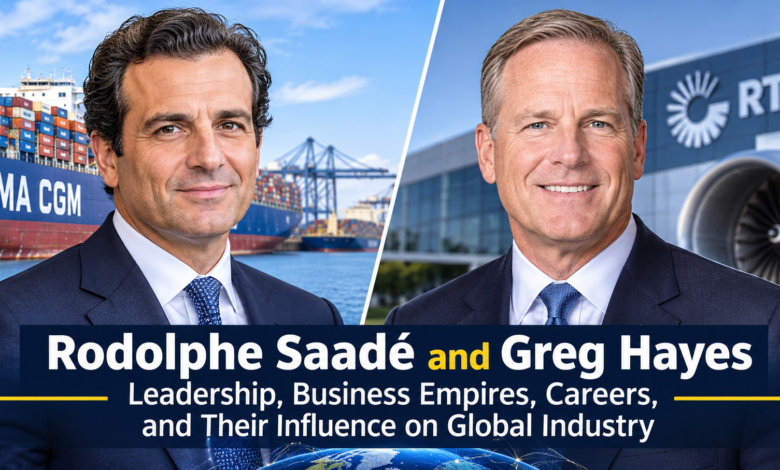
Rodolphe Saadé and Greg Hayes Leadership, Business Empires, Careers, and Their Influence on Global Industry

Introduction
Rodolphe Saadé and Greg Hayes The world of international business is shaped by influential executives who know how to manage complex organizations, navigate economic challenges, and make decisions that influence entire industries. Among the notable names in this environment are Rodolphe Saadé and Greg Hayes. Both have built impressive professional reputations through leadership positions in major global companies, although their careers have followed very different paths.
Rodolphe Saadé is widely recognized for his leadership in the international shipping and logistics industry. As the head of the CMA CGM Group, he has helped guide one of the world’s major container shipping companies through changing trade conditions, technological developments, and the growing importance of global supply chains.
Greg Hayes, meanwhile, is known for his executive career in the American aerospace and industrial sector. His leadership at Raytheon Technologies, now known as RTX, placed him at the center of important developments involving aviation, defense technology, manufacturing, and international business.
Although their professional backgrounds are different, both executives offer interesting examples of how experienced leaders approach large-scale business management. Their stories also highlight the importance of strategic planning, innovation, financial discipline, and adapting to changing markets.
It is worth understanding that Rodolphe Saadé and Greg Hayes should not automatically be presented as business partners or close professional associates. Their relevance to this topic comes primarily from their individual leadership careers and the industries they have influenced.
This article explores their backgrounds, professional achievements, leadership philosophies, business strategies, and wider influence on the global economy. It also examines what their careers reveal about the challenges of leading major international organizations.
1. Who Is Rodolphe Saadé?
Rodolphe Saadé is a prominent international business executive best known for leading the CMA CGM Group, a major French shipping and logistics company. His professional journey is closely connected to the development of international trade and the growing importance of integrated transportation networks. He has played an important role in expanding the company’s operations and strengthening its position in the global shipping market.
Born in Beirut, Lebanon, in 1970, Rodolphe Saadé and Greg Hayes grew up in a family with a strong entrepreneurial background. His father, Jacques Saadé, established CMA in Marseille in 1978. What began as a relatively small maritime transportation business eventually developed into a major international shipping organization. This family business would later become the foundation of Rodolphe’s professional career.
Rodolphe Saadé and Greg Hayes pursued higher education at Concordia University in Montreal, Canada, where he studied commerce and marketing. His academic experience gave him a foundation in business management, commercial strategy, and international markets. Rather than immediately entering the family company, he first explored entrepreneurship by establishing a water-dispenser business.
His early entrepreneurial experience helped him understand the practical challenges of running an organization. Starting a business requires more than a good idea. It involves understanding customers, managing expenses, building relationships, and developing reliable operations. These experiences provided useful preparation for his later responsibilities at CMA CGM.
In 1994, Rod olphe Saadé and Greg Hayesjoined his father’s company. His professional development involved working in different locations and managing several shipping operations. He gained experience in markets such as New York and Hong Kong before taking on broader responsibilities at the company’s headquarters in Marseille. This international exposure helped him understand the commercial realities of shipping across different regions.
Between 1997 and 2000, he managed various shipping lines and subsequently took responsibility for important transatlantic and transpacific operations. These roles introduced him to the complexity of international maritime transportation, where business decisions depend on customer demand, port operations, fuel costs, shipping capacity, and changing trade patterns.
His career continued to progress through senior management positions. In 2010, he became vice chairman and a member of the company’s board. He also supervised a financial restructuring process, demonstrating that his responsibilities extended beyond daily operations into corporate strategy and financial management. His experience eventually prepared him for the company’s highest leadership position. CMA CGM Group+2
2. Rodolphe Saadé’s Rise at CMA CGM
One of the most important chapters in Rodolphe Saadé’s career was his increasing involvement in the strategic development of CMA CGM. The company had already established itself as a major international shipping business under his father’s leadership. However, the global transportation industry was changing rapidly, and the organization needed to strengthen its international reach.
Rodolphe Saadé and Greg Hayes became increasingly involved in major corporate decisions, particularly those involving acquisitions and international partnerships. One significant development was the acquisition of Neptune Orient Lines, commonly known as NOL. This Singapore-based shipping company represented an important opportunity to expand CMA CGM’s presence in the Asian market and strengthen its competitive position.
The NOL transaction demonstrated the importance of strategic acquisitions in the shipping industry. Purchasing another company can provide access to established customers, operational networks, shipping capacity, and valuable commercial relationships. However, successful acquisitions also require careful financial planning and effective integration. Rodolphe Saadé and Greg Hayes involvement reflected his growing responsibilities in corporate expansion.
Another major achievement was his participation in the development of OCEAN ALLIANCE in 2016. The agreement involved CMA CGM, COSCO SHIPPING, Evergreen Line, and OOCL. It created an important operational partnership among major shipping companies, allowing them to coordinate services and improve the efficiency of their international maritime networks.
In February 2017, Jacques Rodolphe Saadé and Greg Hayes appointed Rodolphe as chief executive officer of CMA CGM. Later that year, Rodolphe also became chairman of the board, taking responsibility for guiding the company’s long-term direction. This transition marked a significant moment in the history of the family business because leadership moved to the next generation.
Taking over a global shipping company is a demanding responsibility. Maritime transportation is influenced by international economic conditions, political developments, port capacity, shipping regulations, and changes in consumer demand. A successful chief executive must understand these factors while maintaining relationships with employees, customers, investors, and business partners.
Rodolphe Saadé and Greg Hayes responded by pursuing a broader development strategy that extended beyond traditional container shipping. His vision emphasized transportation, logistics, digitalization, and integrated supply-chain services. Rather than treating shipping as the company’s only major activity, he worked toward building a business capable of supporting customers across several stages of the transportation process. CMA CGM Group+2
3. Business Expansion, Logistics, and Innovation Under Saadé
A major feature of Rodolphe Rodolphe Saadé and Greg Hayes leadership has been the expansion of CMA CGM into logistics services. Traditional shipping companies primarily focus on moving cargo between ports. However, modern businesses increasingly require transportation solutions that connect factories, warehouses, distribution centers, retailers, and final customers.
This changing customer demand helped explain CMA CGM’s acquisition of CEVA Logistics in 2019. CEVA brought additional capabilities in contract logistics and freight management. The transaction supported the company’s ambition to become a more integrated transportation and logistics provider rather than depending entirely on ocean freight.
The strategy became particularly relevant as international supply chains faced unexpected disruptions. Businesses needed alternative transportation arrangements, dependable warehousing, and better visibility into the movement of goods. Companies offering multiple logistics services could potentially provide more flexible solutions than organizations focused on a single transportation method.
Rodolphe Saadé and Greg Hayes also supported the development of CMA CGM’s air cargo operations. In 2021, the company announced the creation of its air cargo division and invested in cargo aircraft. This move expanded its transportation capabilities and provided another option for customers who needed to move goods quickly across international markets.
Air freight and maritime shipping serve different purposes. Ships are particularly useful for transporting large quantities of goods at comparatively economical costs, while aircraft offer faster delivery for time-sensitive cargo. By developing both capabilities, CMA CGM could offer customers a wider selection of transportation services.
The company’s expansion continued through additional acquisitions in 2022. These included Ingram CLS, GEFCO, and Colis Privé. Each transaction supported a different part of the logistics business, including e-commerce fulfillment, automotive logistics, and last-mile delivery. Together, these developments reflected an effort to build a more connected transportation network.
Innovation has also remained part of Rodolphe Saadé and Greg Hayes strategy. In 2022, CMA CGM launched TANGRAM, an innovation and training facility focused on developing future transportation and logistics solutions. The initiative reflects the growing importance of technology, professional training, and operational improvement in a highly competitive international industry. CMA CGM Group+2
4. Who Is Greg Hayes?
Gregory J. Hayes, commonly known as Greg Hayes, is an American business executive recognized for his leadership in the aerospace, defense, and industrial sectors. His professional career includes senior responsibilities at United Technologies Corporation and RTX Corporation. He is particularly associated with major corporate restructuring and the transformation of businesses operating in highly technical industries.
Hayes studied economics at Purdue University, where he developed an academic foundation that supported his later career in corporate finance and management. He also became a certified public accountant, giving him professional experience in financial reporting, accounting, and business performance analysis.
His career at United Technologies Corporation, commonly known as UTC, lasted nearly 21 years. He joined the organization in 1999 through its merger with Sundstrand Corporation. During his time there, he held several senior positions involving finance, corporate strategy, and business development.
Working across different departments gave Hayes a broad understanding of the company’s operations. Financial management requires executives to evaluate profitability, investment priorities, operating costs, and long-term business risks. Corporate strategy adds another layer because leaders must decide which businesses deserve investment and which may no longer fit the company’s direction.
One of his most important appointments came in 2008, when he became chief financial officer of United Technologies. He held this position until 2014. During those years, he developed substantial experience in overseeing the financial performance of a large industrial organization with operations across different markets.
In 2014, Hayes became chief executive officer of UTC. He later became chairman in 2016. His leadership period involved significant changes to the company’s structure, including decisions about its portfolio of businesses and the future direction of its aerospace operations.
Unlike Rodolphe Saadé and Greg Hayes , whose career developed within a family-founded shipping business, Hayes built his professional reputation through a long corporate career in an established American industrial organization. Their backgrounds illustrate two different routes to senior executive leadership: growing within a family enterprise and progressing through a large corporate management structure. PSX+1
5. Greg Hayes and the Transformation of United Technologies
Greg Hayes became particularly influential through his efforts to reshape United Technologies Corporation. Large industrial organizations sometimes operate across several unrelated markets, making management complicated. Different divisions may require different investment strategies, technologies, customer relationships, and operational priorities.
Hayes pursued a strategy focused on sharpening UTC’s business structure. Rather than maintaining every activity under one corporate organization, the company began concentrating more heavily on aerospace. This approach reflected the belief that a clearer business focus could improve strategic decision-making and help management allocate resources more effectively.
An important part of this transformation was the 2015 divestiture of Sikorsky Aircraft. Sikorsky was a significant helicopter manufacturer, but the transaction formed part of a wider effort to reshape the company’s portfolio. Divestitures can be difficult because they involve employees, customers, suppliers, assets, and long-standing business relationships.
Hayes also led UTC’s acquisition of Rockwell Collins in 2018. Rockwell Collins brought additional aerospace capabilities, including aircraft electronics, communication systems, and avionics technologies. The acquisition strengthened UTC’s position in the aviation supply chain and supported its broader aerospace strategy.
However, corporate restructuring did not stop with acquisitions. In 2020, UTC separated Otis Elevator Company and Carrier Corporation into independent publicly traded businesses. These moves allowed the organizations to pursue their own commercial strategies while giving the remaining aerospace operations a more focused corporate structure.
The separation of these businesses was a major organizational undertaking. Executives had to consider financial arrangements, governance structures, employee responsibilities, operational systems, and shareholder interests. Such changes require careful coordination because the success of a corporate separation depends on more than simply announcing a new company structure.
Ultimately, Hayes helped prepare the foundation for the formation of RTX through the combination of UTC’s remaining aerospace businesses with Raytheon Company in 2020. The transaction brought together Pratt & Whitney, Collins Aerospace, and Raytheon’s defense-related operations under a new corporate structure. It became one of the defining developments of his executive career. PSX+1
6. Greg Hayes and the Formation of RTX Corporation
The formation of RTX Corporation was one of the most significant corporate developments associated with Greg Hayes. Previously known as Raytheon Technologies, RTX emerged from the 2020 combination of United Technologies Corporation’s remaining aerospace businesses and Raytheon Company. The merger brought together organizations with complementary capabilities in aviation and defense technology.
The strategic thinking behind the combination involved creating a company with a broader range of technical expertise. Collins Aerospace specializes in aircraft systems, avionics, and related technologies, while Pratt & Whitney is known for developing and manufacturing aircraft engines. Raytheon brought additional expertise in defense systems, sensors, and advanced technologies.
For Hayes, bringing these businesses together represented a major leadership challenge. Combining large organizations requires more than merging financial statements and corporate structures. It involves aligning management teams, integrating operating systems, coordinating research programs, and establishing shared business priorities.
The aerospace industry also operates under demanding technical and regulatory requirements. Aircraft engines and aviation systems must meet strict safety standards, while defense technologies involve complex government contracts and security considerations. A company operating across these markets must balance innovation with reliability, compliance, and financial performance.
Hayes served as chief executive officer of RTX and later became chairman. In 2024, he transitioned into the role of executive chairman following the conclusion of his chief executive tenure. He subsequently served as a special adviser before completing that advisory role in January 2026, according to the current corporate biography published by BD.
His time at RTX placed him in a position where business decisions could influence commercial aviation, defense procurement, manufacturing, and technological development. The company’s scale also meant that its activities involved a substantial international workforce, customers, and supplier network.
The significance of Hayes’s leadership therefore extends beyond the formation of a single corporation. His career illustrates how corporate executives can reshape established industrial organizations through acquisitions, divestitures, mergers, and long-term strategic planning. PSX+1
7. Rodolphe Saadé and Greg Hayes: Leadership Styles Compared
Although Rodolphe Saadé and Greg Hayes operate in different industries, their professional experiences offer an interesting comparison of modern corporate leadership. Both have managed large organizations where decisions can affect international customers, employees, suppliers, and business partners.
Rodolphe Saadé and Greg Hayes leadership has focused heavily on expansion and diversification. His work at CMA CGM demonstrates an effort to connect maritime transportation with logistics, air cargo, and additional supply-chain services. This approach reflects the changing expectations of businesses that increasingly prefer integrated transportation solutions.
Hayes, on the other hand, became particularly associated with corporate restructuring and portfolio management. His leadership at UTC involved separating certain businesses, acquiring aerospace capabilities, and combining major operations to create RTX. His career highlights the importance of deciding where a company should concentrate its resources.
Their approaches also reflect different industry requirements. Shipping businesses must coordinate vessels, ports, cargo schedules, fuel consumption, and international trade routes. Aerospace and defense companies must manage highly specialized manufacturing, research, safety standards, and long-term government or commercial contracts.
Another interesting difference concerns their professional backgrounds. Rodolphe Saadé and Greg Hayes entered the family-founded CMA CGM business after gaining education and entrepreneurial experience. He gradually moved into leadership through operational and strategic roles. Hayes developed his career through finance, corporate management, and executive appointments at United Technologies.
Despite these differences, both executives demonstrate the importance of understanding financial performance. Large companies cannot rely on expansion alone. They must carefully evaluate investments, manage operating costs, maintain customer confidence, and ensure that new projects support long-term objectives.
Their careers also highlight the value of international experience. Rodolphe Saadé and Greg Hayes worked across different global shipping markets, while Hayes led companies involved in international aerospace and defense operations. Understanding regional markets and international business relationships is essential when managing organizations that operate across national boundaries.
Ultimately, their leadership stories show that there is no single formula for running a successful multinational company. Some executives concentrate on expansion and diversification, while others emphasize restructuring and operational focus. Both approaches can create opportunities when supported by careful planning and effective execution.
8. Are Rodolphe Saadé and Greg Hayes Connected?
One important question surrounding the keyword Rodolphe Saadé and Greg Hayes is whether the two executives share a direct personal or professional relationship. Because both are prominent international business figures, their names may appear together in online searches and business-related discussions.
However, it is important to separate professional comparisons from documented relationships. Public corporate biographies identify Rodolphe Saadé and Greg Hayes with CMA CGM and Hayes with United Technologies, RTX, and other corporate board responsibilities. These biographies establish their individual careers but do not establish a direct business partnership between them.
There is no confirmed public evidence in the authoritative corporate biographies reviewed for this article that identifies the two men as relatives, business partners, co-founders, or participants in a jointly announced venture. This does not prove that they have never met or communicated privately. It simply means that a direct relationship should not be presented as an established fact.
Their professional interests do have some broader industry connections. CMA CGM operates in international transportation, including air freight, while Hayes spent much of his career leading organizations involved in aviation technology and aerospace manufacturing.
Air cargo depends on a complex network of services. Airlines need aircraft, engines, maintenance systems, airport infrastructure, cargo-handling facilities, and logistics providers. These activities involve many different companies, including organizations operating in the aerospace and transportation industries.
This creates an indirect connection through the wider global aviation ecosystem. However, participating in related industries does not automatically mean that two executives have worked together or maintained a formal business relationship.
For readers researching both individuals, the most accurate approach is to examine their respective companies, professional histories, and documented achievements separately. Their comparison is valuable because it reveals how leaders in different sectors approach business growth, technology, and organizational transformation.
Therefore, the relationship between Saadé and Hayes is best understood as a professional comparison rather than a confirmed partnership. Keeping this distinction clear makes an article more reliable and prevents unsupported claims from becoming part of the narrative. CMA CGM Group+2
9. Their Influence on Global Trade, Technology, and the Economy
Rodolphe Saadé and Greg Hayes have influenced different parts of the international business environment. Their industries may appear separate at first, but both are essential to the functioning of the modern global economy. Transportation, manufacturing, aviation, and international trade depend on organizations that can deliver reliable services across borders.
Rodolphe Saadé and Greg Hayes work at CMA CGM is closely connected to the movement of physical goods. Container shipping supports international commerce by transporting products between manufacturers, suppliers, distributors, and retailers. Everything from consumer electronics and clothing to industrial equipment depends on efficient transportation networks.
The importance of this industry became especially visible during major supply-chain disruptions. When shipping routes become congested or transportation capacity becomes limited, companies can experience delays, higher costs, and difficulties meeting customer demand. Shipping executives must therefore consider operational efficiency and resilience when developing long-term strategies.
Hayes’s influence comes from a different part of the economic system. Aerospace companies develop technologies that support commercial aviation, aircraft maintenance, military operations, and advanced manufacturing. Their products and services help airlines operate aircraft and enable governments to maintain sophisticated defense capabilities.
The aerospace sector also depends heavily on research and development. Aircraft engines, navigation systems, communication equipment, and other technologies require years of engineering work. Companies must invest in innovation while ensuring that their products meet demanding technical and safety requirements.
Another important similarity is the relationship between technology and business competitiveness. CMA CGM has invested in digital transformation and logistics innovation, while the companies led by Hayes have been involved in advanced aerospace and defense technologies. In both cases, organizations need skilled employees and modern infrastructure to remain competitive.
Their careers also demonstrate how corporate decisions can influence employment and investment. Large transportation and aerospace companies work with extensive networks of suppliers, contractors, and service providers. Changes in corporate strategy can therefore have economic consequences that extend beyond the companies themselves.
Looking at their professional achievements together provides a broader understanding of the modern economy. Rodolphe Saadé and Greg Hayes work highlights the importance of moving goods efficiently, while Hayes’s career demonstrates the importance of engineering, manufacturing, and technological development. Both fields contribute to the infrastructure that supports international business.
10. Personal Values, Professional Reputation, and Long-Term Legacy
A business leader’s professional reputation is shaped by more than company performance. Experience, decision-making, organizational culture, relationships, and long-term priorities all influence how executives are viewed by employees, customers, and industry observers.
Rodolphe Saadé’s career reflects the importance of entrepreneurial continuity. His father established CMA CGM, but Rodolphe developed his own professional experience through different business responsibilities before becoming its chief executive. This combination of family-business knowledge and operational experience became an important part of his leadership background.
His educational experience at Concordia University also remains an important part of his professional story. The university recognized his achievements with an honorary Doctor of Laws degree in 2023. This recognition highlighted his contributions to business leadership and the development of an international transportation and logistics organization.
Rodolphe Saadé and Greg Hayes has also supported initiatives involving humanitarian assistance and social development through the CMA CGM Foundation. The foundation, established in 2005, has supported projects related to emergency humanitarian relief, education, and equal opportunities. These activities reflect the company’s broader involvement in social and community initiatives.
Environmental responsibility is another important issue within the shipping industry. Maritime transportation plays a major role in international commerce, but it also faces pressure to reduce emissions and improve fuel efficiency. CMA CGM has announced several sustainability initiatives, including investments in alternative-energy vessels and a target of net-zero carbon emissions by 2050.
Greg Hayes’s professional reputation, meanwhile, is strongly associated with corporate financial management and organizational transformation. His career involved major strategic decisions at UTC and RTX, including acquisitions, business separations, and the formation of a large aerospace and defense organization.
After his executive career at RTX, Hayes continued serving in corporate governance positions. His current professional biography identifies him as the lead independent director of Phillips 66 and a director of Becton, Dickinson and Company. These responsibilities reflect the continuing value placed on his financial, strategic, and governance experience.
The long-term legacies of both executives will ultimately depend on how their decisions influence their organizations and industries over time. Rodolphe Saadé and Greg Hayes story is closely tied to the expansion of global logistics, while Hayes’s legacy is associated with the restructuring of major industrial and aerospace businesses. Both careers offer useful lessons about leadership, strategic thinking, and the responsibilities that come with managing large international organizations. Concordia University+3
11. Conclusion
Rodolphe Saadé and Greg Hayes represent two different but equally interesting examples of international business leadership. Their professional careers have developed in separate industries, yet both demonstrate the importance of strategic planning, financial knowledge, innovation, and organizational management.
Rodolphe Saadé has established himself as a leading figure in global shipping and logistics through his work at CMA CGM. From managing shipping lines to overseeing major acquisitions and expanding into air cargo, his career reflects an ongoing effort to develop a more integrated transportation business.
Greg Hayes has built his reputation through a long career at United Technologies and RTX. His leadership involved major corporate transformations, including the separation of business divisions, the acquisition of aerospace capabilities, and the formation of a major aerospace and defense company.
Although their names are discussed together, there is no publicly verified direct business partnership between them in the corporate records reviewed. Their connection is better understood through their shared position as influential executives operating within important parts of the global economy.
For readers interested in business leadership, their careers provide valuable examples of two different approaches to corporate development. Rodolphe Saadé and Greg Hayes illustrates the importance of expansion and diversification, while Hayes demonstrates the value of restructuring and strategic focus.
Their stories also highlight how modern business leaders must respond to changing technology, international competition, economic uncertainty, and growing customer expectations. These challenges require flexibility, careful decision-making, and a clear understanding of long-term business objectives.
Ultimately, Rodolphe Saadé and Greg Hayes have each contributed to shaping major organizations in their respective fields. Their professional journeys offer useful insights into the complexity of international business and the decisions required to lead large companies successfully.
Frequently Asked Questions (FAQs)
1. Who is Rodolphe Saadé?
Rodolphe Saadé is a Lebanese-born French business executive who serves as chairman and chief executive officer of CMA CGM Group. He is recognized for his leadership in international shipping, logistics, and transportation.
2. Who is Greg Hayes?
Greg Hayes is an American business executive best known for his former leadership positions at United Technologies Corporation and RTX. He has played an important role in major corporate restructuring and aerospace industry developments.
3. Are Rodolphe Saadé and Greg Hayes business partners?
There is no publicly verified evidence establishing a direct business partnership between Rodolphe Saadé and Greg Hayes. They are known primarily for their individual careers in different industries.
4. What company does Rodolphe Saadé lead?
Rodolphe Saadé leads CMA CGM Group, an international shipping and logistics company headquartered in Marseille, France.
5. What was Greg Hayes’s role at RTX?
Greg Hayes served as chief executive officer and chairman of RTX. He was also involved in the 2020 merger that brought United Technologies’ remaining aerospace businesses together with Raytheon Company.
6. What is the biggest difference between their careers?
Rodolphe Saadé and Greg Hayes career has focused on expanding a global shipping and logistics business, while Hayes’s career has centered on financial management, aerospace development, and corporate restructuring.
7. Why are Rodolphe Saadé and Greg Hayes discussed together?
Their names can be explored together because both are influential international executives whose decisions have affected major industries. Their careers provide an interesting comparison of business leadership, even though no direct professional partnership has been established.